Progetto BioClima


Issues
Wetlands, such as the Torbiere del Sebino Nature Reserve, are among the most threatened habitats on the planet. In Europe, 90% of these habitats have disappeared over the last 100 years. The main factors negatively affecting them are human activities, climate change and the natural process of silting up. Therefore, active management is necessary to maintain these areas in a good state of conservation.
In the Reserve, flooded vegetation is steadily declining, resulting in the loss of a habitat that is essential for waterbirds, amphibians and many insect species. Furthermore, the high volume of vehicle traffic along the Reserve’s boundaries has a constant negative impact.
Solutions
The application for a non-repayable capital grant therefore arises from the need to carry out active management measures for the Reserve’s natural heritage, with the aim of conserving biodiversity, adapting to climate change and enhancing ecosystem services.
In particular, the objectives are to:
- Improve the conservation status of habitats and species in line with the Regional Prioritised Action Framework 2021–2027;
- Increase the area of habitat available for biodiversity conservation;
- Strengthen the regional and local ecological network;
- Enhance green infrastructure in line with the provisions of the Regional Territorial Plan and the Regional Landscape Plan;
- Increase the provision of ecosystem services and enhance their economic value;
- Make both habitats and human communities more resilient to climate change.
The BioClima Call for Proposals, developed within the framework of the LIFE GESTIRE 2020 project and funded through the “Piano Lombardia”, was launched in spring 2022. It aims to create public-private financing models to catalyse investment in biodiversity conservation and climate change adaptation projects in Lombardy’s forests and protected areas, thereby contributing to the protection of 12 ecosystems and 70 animal species. It represents a successful example of public-private co-financing through the use of the WowNature platform.
Through this initiative, private individuals and businesses had the opportunity to contribute to biodiversity conservation by purchasing trees that were subsequently planted in the Reserve. Although the project has ended, it is still possible to donate a tree to the Reserve.
Actions carried out
Forest improvement
One of the main interventions carried out as part of the project involved forest improvement across the entire northern section of the Reserve, including the area around the Visitor Centre up to the warehouse area. Approximately 4,500 wetland plants belonging to 13 different species were planted, with the necessary supports (protective shelters and marker canes). The aim was to create a buffer zone acting as a filter against air pollutants and noise disturbance, thereby protecting protected bird species from the impact of the main road. As the land was in a degraded condition, preliminary work was carried out to clear the area, thin out vegetation, remove invasive plants and collect waste. The planting activities were then completed.
In addition to the company contracted to carry out the work, the activities involved individual volunteers, the Reserve’s guides, the Iseo Diving Group, and the Civil Protection teams of the Sebino Bresciano Mountain Community and Palazzolo sull’Oglio.
Approximately 18 months after planting, monitoring activities were carried out, showing a plant survival rate of around 80%.


Safeguarding biodiversity
Three new wetlands were created, covering a total area of approximately 756 m², to provide suitable breeding sites for amphibians and feeding areas for birds.
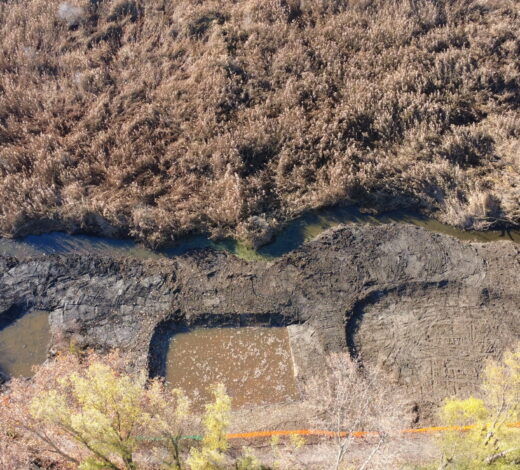
To counteract drought and the silting-up caused by vegetation growth, an existing wetland was expanded by excavating a basin within the reed bed, with gradually decreasing depths, to support the conservation of waterbirds. This involved excavation and removal of the soil. The aim was to recreate a flooded marsh habitat and rejuvenate the vegetation succession, ensuring ideal nesting and feeding conditions for 14 target species, including the Eurasian bittern, the Purple Heron and the Little Crake. The expansion and conservation of isolated ponds also help safeguard amphibian populations.


A 500-metre stretch of infilled water network was restored, providing suitable habitat for the reproduction of amphibians and aquatic insects.


Another highly specific intervention involved planting 2,500 Cladium mariscus seedlings to expand the Reserve’s most important vegetation habitat, habitat 7210: Calcareous fens with Cladium mariscus, whose conservation is considered a priority by the European Union. Its presence within the Reserve is particularly significant, as it represents the only site within a protected area in eastern Lombardy.


A new forest habitat, 91F0: Riparian mixed forests of large rivers, has been created.
Furthermore, a new habitat, code 3260, consisting of slowly flowing ditches with Ranunculus trichophyllus and Callitriche species, has been recorded along the restored water network in the Iseo area.
Environmental education
- “SOTTO-SOPRA”: aimed at primary and secondary schools in the local area, this programme explored biodiversity and environmental conservation. A total of 23 classes took part, reaching 424 students through guided tours and educational workshops.
- “FUORI CLASSE”: this programme was designed for the comprehensive school institutes in the municipalities of Iseo, Corte Franca and Provaglio d’Iseo. Its aim was to help children and young people understand the role of nature and biodiversity in mitigating climate change, strengthen environmental awareness and understanding of the ecological transition, and foster a closer relationship between people and nature. The programme concluded with a final event featuring an exhibition of projects created throughout the school year. The young authors presented and explained their work, sharing their experiences with families and members of the local community.
- “SETTIMANA VERDE – Nature Olympics”: a week-long day summer camp held at the Visitor Centre within the Reserve, aimed at children aged 6 to 13. The camp took place from Monday 19 to Friday 23 June 2023. The initiative was a great success, receiving as many as 60 registration requests, far exceeding the maximum capacity of 35 participants.


Certification
The Reserve Authority is committed to managing the certified area in a way that promotes biodiversity conservation, pursuing the following objectives:
- Ensure the safety and accessibility of trails;
- Improve environmental conditions in order to increase the number of breeding bird species;
- Improve and maintain woodland areas;
- Control invasive vegetation;
- Maintain small wetlands in good condition in order to increase amphibian populations;
- Raise awareness of biodiversity through environmental education activities.